The Kraken has emerged from the corn field! (Drone photo courtesy of DMZ Aerial http://www.dmzaerial.com/)
The maze has been cut into the field and all the paths have been tilled. Now, we’ll check the photos against the design for accuracy, and adjust either the corn field or the map as necessary. And the corn needs to grow about another five feet or so–it’s 3-4 feet tall right now, but at this stage it can grow 4-6 inches a day if it’s hot.
This is the first time we’ve had a drone take the preliminary photos, and we are super impressed–both with how well the photos turned out, and about how much fun it was to have the drone flying around. Mitchell Fiene with DMZ Aerial (http://www.dmzaerial.com/) stopped by with our nephew (who is in the ag industry) and we got a look at the future of crop scouting.
OK, drones are the future of a lot of things, but they are very big in the agriculture industry right now–it’s incredible to be able to look for crop damage from the air. Mitchell even said he was hoping to be able to swoop down and look for pest species of insects–the drones can take great photos from above, as in our maze photo, but also have the capability to fly very low with the high resolution camera. I suggested he come back in a couple of weeks and we’d probably have some cucumber beetles in our pumpkin patch (he was thrilled.)
We have the occasional “discussion” here at the farm (ranging from will we have enough pumpkins to who isn’t doing their fair share of laundry), but our most recent conflict came over the Golden Spiral. Which is interesting on several levels: it’s only been since 2010 that the Golden Spiral (derived from the Golden Ratio) has existed in our minds as a topic of discussion; most people don’t argue about it; it is an example of mathematics in use in an ordinary household; and it distracted us from another round of “the reason no one has underwear is that the laundry pile has eaten all of it.”
The Golden Spirals in question: tentacles in the Kraken Maze
A lot of the arms of the squid end in Golden Spirals by design–they look great, and they also give us an opportunity to use the concept in field trips and in math connections on our website and for when we do presentations at schools. I overlay the Golden Rectangle template on the cutting map to make it easier to lay out in the field.
I brought this section of the map out to show how to cut the spirals, and when I explained that the spiral was made up of a series of quarter circles with radii that are the sides of the squares, I showed this picture as a how-to:
How to draw a Golden Spiral
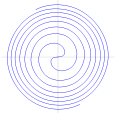
Alan didn’t believe that it would work out like this. He tried to describe his reasons for disagreeing with me, but we quickly ran into a lack of vocabulary to frame the issue: he just kept saying that spiral doesn’t work like that, and I just kept saying (in all caps) that BY DEFINITION a Golden Spiral has to be drawn like this, and then we got out a compass, which showed that I was right (in the sense that the quarter-circle technique would work in the field)–but we were still confused. So, why does the Golden Spiral work like that? What if I’d made another kind of spiral–would there be a shortcut then?
Alan’s position was, in essence, that a spiral should, BY DEFINITION, have a constant rate of change, so you shouldn’t be able to put together a series of quarter circles to make it.
He’s had very little academic math but a lot of practical, real-world math. I’ve had some academic math (through a couple of semesters of calculus, a while ago) and an interest in math in general–just the interesting parts, though. Between the two of us, we came up with the ideas that yes, this rectangle overlay will help when cutting the maze, but if we’d put in another kind of spiral it wouldn’t work.
Then we had a brief but fascinating discussion about mathematical intuition and folk physics and being a veterinarian vs. being a farmer, and then we segued into Newtonian and non-Newtonian and Euclidean and non-Euclidean realms (okay, that was actually just me talking and everyone else edging out the door.) Alan and the rest of our maze cutting crew headed out in to the real world to actually get something done and I just went to the computer and googled why can you make a golden spiral using a golden rectangle, and related search terms.)
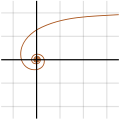
And the [short] answer is: there are different kinds of spirals (which is obvious) and the Golden Spiral is a special one that gets larger by a factor of
for every quarter turn (BY DEFINITION!) and that for other spirals, you don’t necessarily have that every quarter-turn constraint–most of them just get larger continuously, as Alan predicted.
So, it’s good I picked the Golden Spiral for use in the squid, because the rectangle template makes them “easy” to cut…
Here are some pages to explore for a better explanation of this topic
https://treinenfarm.com/wp-content/uploads/2025/04/golden-spiral-tenatcles-only.jpg15641462Treinen Farm/wp-content/uploads/2025/04/logo-best-corn-maze-wisconsin-padding-300x196.pngTreinen Farm2013-07-08 10:44:282025-04-30 12:53:53Heated Discussion over Golden Spiral
Maze plan with grid and cutting aids (circles and golden spiral templates) overlaid
So, contrary to popular belief, the corn maze does not simply appear in our cornfield one day…it would be awesome to wake up one morning and find a giant squid visible from the tower, but alas, we need to rely on forced labor (OK, not really forced…) in the hot sun to get the design in the field.
Here’s how we do it:
1) Finalize the design. This can involve heated discussions between the designer (Angie) and the farmer (Alan) but eventually we come up with the plan.
3) Stake the cornfield. This allows the workers to figure out where they are and relate that to the plan, which is printed out on a grid. We don’t use GPS, as our design is so complex it would be difficult to get the accuracy we need.
4) Transfer the design from the grid on the page to the grid in the field, using paint and flags to mark the trails.
5) Mow the trails as a preliminary step–corn that has been mowed off at this stage will still grow back, so if a mistake has been made, it will hopefully be caught before the next step…
6) Till out the trails. This removes the corn plants, and so the tilled trails are “permanent”–they had better be in the right spot! (although Alan has been known to take “artistic liberties” with the design on several occasions.)
Sometimes the reaction to the design is “Are you kidding me? You want me to cut that!?”
Sections can be enlarged to help get the details right–trails must be laid out accurately to 6 inches.
For perfect circles, we find the center point, measure the radius, and paint the circle. This year’s maze has a LOT of circles…which is good (check out all of those circles on the tentacles!)
Once a trail is marked with paint or flags (and double-checked against the plan), we mow the corn short.
The crew leader consults with everyone who is marking and checks over the layout. It takes about a week to get the design in the field.
Tilling is the last step–it’s the equivalent of drawing in pen, because it removes the corn permanently.
Finally! The design for 2013 is finished, and the crew is working on getting it cut into the field!
The inspiration for this year’s maze started with thinking about octopi, which are one of my favorite animals.
I collected a lot of images of octopi, but I realized that an octopus wasn’t quite exciting enough on its own…but a giant squid, or better yet, a Kraken, is definitely maze-worthy.
Once I settled on the squid, I found some old maps that had sea monsters and often really ornate compass roses, which worked well.
I tried to fit in some other images, like the face of the wind blowing and the ship sailing over the edge of the world, but they didn’t work within the size of the field.
Here There Be Monsters–perfect theme for our 2013 corn maze
Maze Design 2013: The clock is ticking, so it’s time to engage in some useful procrastination as I sit down to do the maze design…
Part of the brainstorming process for maze design is in free-associating with ideas and images until some kind of coherent, useful theme coalesces out of the maelstrom. Here are some thoughts that have made it onto one list or another and I found in my maze design folder:
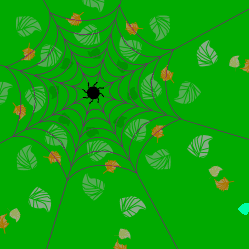
optical illusions; spiders; webs; carousels; gardens;trees; snakes (coiled, see Navaho sand paintings); maps; compass rose; DNA; life sciences–animals/insects/plants/viruses/bacteria/prions
Les Caux cave paintings; drones (as in UAVs); Platonic solids; triangles; three-dimensional designs; exploded views; snake eating its tail; Galapagos tortoises; moon; Singularity; sphere; torus; visual paradoxes;
Map of prime numbers; crop circles; hawk/eagle; unicorn; badger; bees/beehive; octopus; owls; tapestries; planets; solar systems/galaxies
https://treinenfarm.com/wp-content/uploads/2025/04/spiderinweb-rotational-symmetry1.gif249249Treinen Farm/wp-content/uploads/2025/04/logo-best-corn-maze-wisconsin-padding-300x196.pngTreinen Farm2013-05-24 10:46:032025-04-30 12:49:33List of Random Maze Design Ideas (in no particular order or relevance…)
I think that the thing that Alan and I love most about our corn maze is the process of creation–all of it, from brainstorming and sketching, to actual design, and then to the task of carving it into the corn field. This year, we’ve partnered with the Center for Engagement in Madison WI , to turn our incredibly fun but private process into something that can be actually experienced by young people: the very first “Maze Mania” summer camp.
The camp will consist of twelve kids and three teachers, and their task will be to work with Alan and I as they learn the maze design and cutting process. And it’s not easy work: they’ll be challenged to come up with a design (for the Children’s Maze) that meets very specific parameters, and part of the camp is spent actually cutting the maze into the cornfield on a (probably) hot summer day.
For me, the camp is about sharing the joyfulness of math and design art and seeing a project through from the beginning to completion. I spend a good week designing the big maze, and Alan spends another week cutting it, so in early summer we just living and breathing the maze 24/7. It’s pretty intense, but fun. It’s not often that a real-world business has a process like this that is both interesting and accessible to young people, so we are eager to share the experience.
https://treinenfarm.com/wp-content/uploads/2025/04/2013-05-01-16-35-30-scaled.jpg19202560Treinen Farm/wp-content/uploads/2025/04/logo-best-corn-maze-wisconsin-padding-300x196.pngTreinen Farm2013-05-23 10:46:032025-04-30 12:42:48The Making of a Maze Summer Camp
We may request cookies to be set on your device. We use cookies to let us know when you visit our websites, how you interact with us, to enrich your user experience, and to customize your relationship with our website.
Click on the different category headings to find out more. You can also change some of your preferences. Note that blocking some types of cookies may impact your experience on our websites and the services we are able to offer.
Essential Website Cookies
These cookies are strictly necessary to provide you with services available through our website and to use some of its features.
Because these cookies are strictly necessary to deliver the website, refusing them will have impact how our site functions. You always can block or delete cookies by changing your browser settings and force blocking all cookies on this website. But this will always prompt you to accept/refuse cookies when revisiting our site.
We fully respect if you want to refuse cookies but to avoid asking you again and again kindly allow us to store a cookie for that. You are free to opt out any time or opt in for other cookies to get a better experience. If you refuse cookies we will remove all set cookies in our domain.
We provide you with a list of stored cookies on your computer in our domain so you can check what we stored. Due to security reasons we are not able to show or modify cookies from other domains. You can check these in your browser security settings.
Google Analytics Cookies
These cookies collect information that is used either in aggregate form to help us understand how our website is being used or how effective our marketing campaigns are, or to help us customize our website and application for you in order to enhance your experience.
If you do not want that we track your visit to our site you can disable tracking in your browser here:
Other external services
We also use different external services like Google Webfonts, Google Maps, and external Video providers. Since these providers may collect personal data like your IP address we allow you to block them here. Please be aware that this might heavily reduce the functionality and appearance of our site. Changes will take effect once you reload the page.
Google Webfont Settings:
Google Map Settings:
Google reCaptcha Settings:
Vimeo and Youtube video embeds:
Other cookies
The following cookies are also needed - You can choose if you want to allow them:
Privacy Policy
You can read about our cookies and privacy settings in detail on our Privacy Policy Page.