Visit us at the Treinen Farm Corn Maze & Pumpkin Patch!
W12420 WI Trunk 60
Lodi, WI 53555

Don’t Miss a Thing!
Get our newsletter to get ticket deals, event announcements and other amazing news!
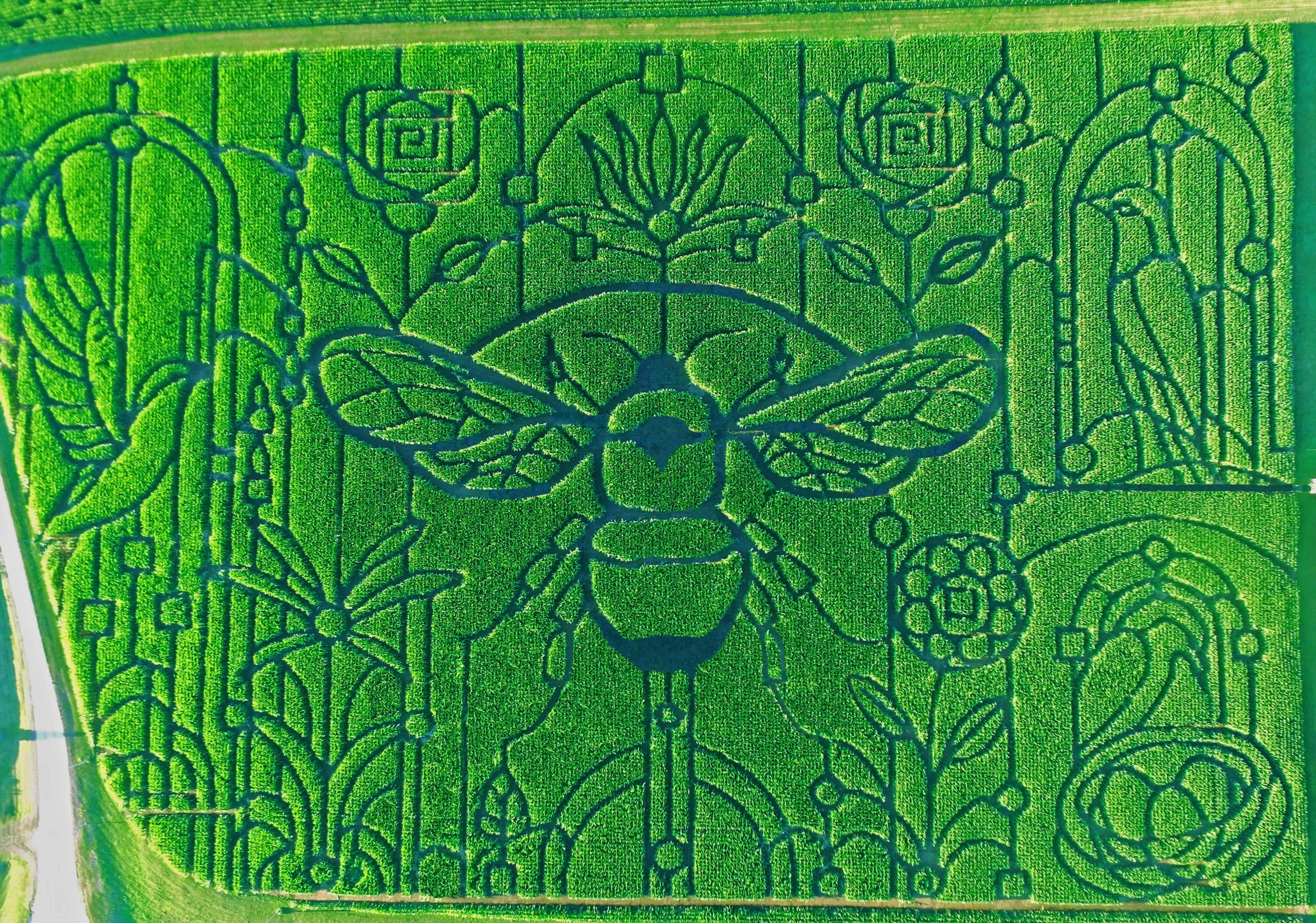
TL;DR: Angie got fooled by an opossum, obsessed over a nest-pirating owl, and designed a giant Art Nouveau bird and bee themed maze. Come get lost in the corn and learn how everyone makes babies. (Family-friendly. Nature did the joke, not us.)
I’ll be honest about how this theme got chosen: Our son Patrick wanted to do an insect maze, and then Jason (our business coach) suggested “The Birds and the Bees.” Everybody laughed. Then every time we’d say it out loud in a meeting — the birds and the bees — and there would be this pause, and then more laughing. Think of the possibilities! And when a maze theme makes your whole team laugh every single time it comes up, months before you’ve cut a single path in the corn, you should probably pay attention. What’s not to love about the birds and the bees?
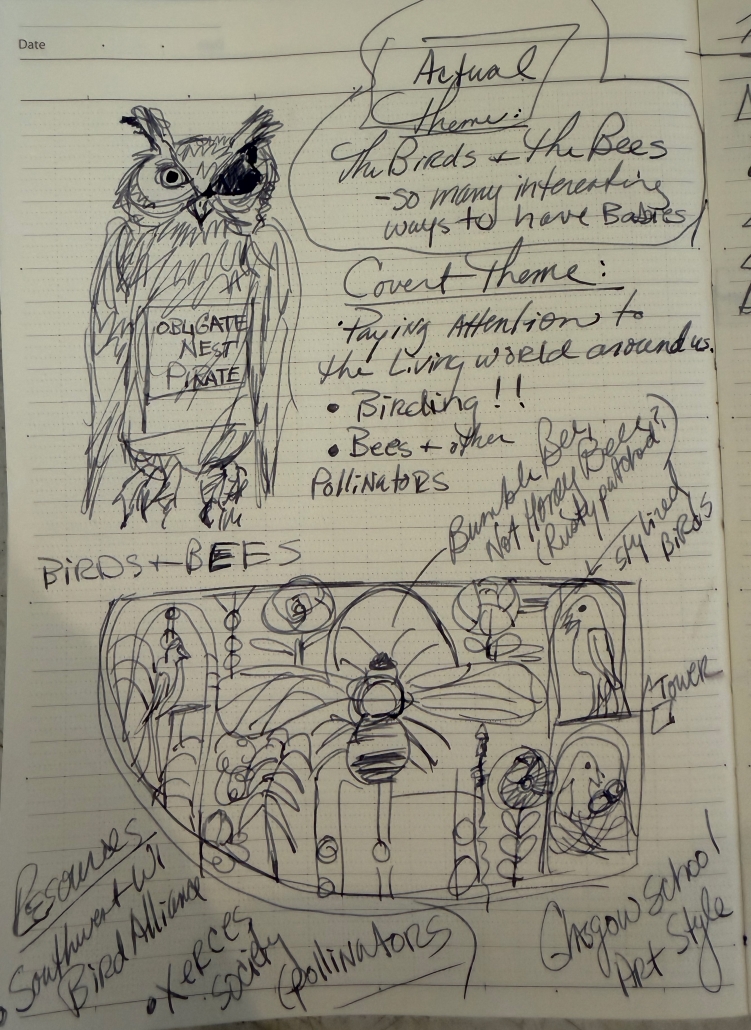
Page from Angie’s notebook with a sketch idea for 2026 maze
But the question that actually decides the theme isn’t “what would look cool in corn.” It’s the question I find myself coming back to every year: what does the world need from us right now? In 2020, I thought the answer was resilience, and we got a water bear. In 2021, it was physics, and we got Schrödinger’s Cat. This year, I think the answer is awareness. Presence. Actually noticing the living world that’s already all around you — which, it turns out, is a thing the birds and the bees are very good at teaching.
Obviously, we’re a farm that welcomes all ages, and everything we do is family-friendly. But here’s the thing I love most about this theme: “The Birds and the Bees” is the phrase people use to avoid talking about reproduction. But bees pollinating flowers and bird nesting strategies are reproduction. It’s not a euphemism at all. Nature is out here giving The Talk constantly, in public, all season long, and it is stranger and funnier and more beautiful than anything we could make up.
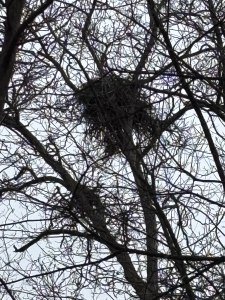
Zooming in on the stick nest high up in a hickory tree.
Somewhere in the middle of all this, in February or March, I became convinced there was a great horned owl nest in our woods. My actual evidence was: a nest, at the very top of a really tall hickory tree, and one day when I maybe heard an owl near it. That’s it. That was the whole case. But I kept hiking over there to check on it, and we started looking into whether we could watch the nest — maybe get a trail camera or something on it.
And in the course of that research we discovered the phrase that may have sealed this year’s theme: great horned owls are obligate nest pirates. They never build their own nests — not “usually don’t,” but can’t. Every great horned owl family begins by commandeering a nest built by a hawk or a crow or a squirrel. You HAVE to be a pirate if you are a great horned owl. I don’t know why this delighted me as much as it did, but I kept bringing it up in every conversation, and I still think I need a t-shirt that says OBLIGATE NEST PIRATE.
That was the door into what became a running theme for us: all the different ways to have babies. Because once you start looking, reproduction in nature is a festival of weird strategies. Owls that steal nests. Killdeer that fake injuries to protect theirs. Cowbirds that lay eggs in songbirds’ nests. A queen bumble bee who wakes up alone every spring and creates an entire colony by herself.
And opossums. I don’t think everyone realizes that opossums are marsupials — you’d think you’d have to go to Australia to see a marsupial, but no, you can just stay up late and walk around the woods, which is what I was doing the other night when I saw one. And here is my confession: I am literally a veterinarian. I have a degree in zoology. And I am SO easily fooled by opossums. This opossum was running — actually running — and I must have looked away for one second, and when I looked back it was lying there dead. All I could think was “what ON EARTH could possibly have happened to this opossum in the last ten microseconds??” (It was not dead. It was playing dead. It is a very realistic death play.) This is not the first time a opossum has fooled me, and I’ve accepted it will not be the last. (Second t-shirt idea: EASILY FOOLED BY OPOSSUMS.)
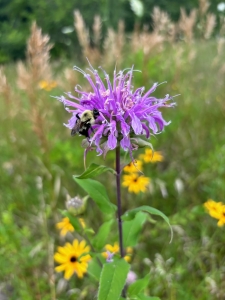
Bumble bee on the bee balm. It’s hard to get good photos because they move so fast!
When we started designing, we decided the central figure of the maze would be a bumble bee. And not just any bumble bee: in 2017, the rusty patched bumble bee became the first bumble bee ever placed on the endangered species list in the continental United States, and southern Wisconsin is one of its last strongholds. This is a creature whose story intersects with ours — the prairie we’ve been restoring on the bluff is exactly the kind of habitat she needs*.
For the art, I went back to a style I fell in love with while designing the 2022 Biophilia maze: the Glasgow Style of Charles Rennie Mackintosh. Stylized natural forms, flowing lines — birds that look like they belong in stained glass. I wanted a really beautiful maze this year, because with birds and bees, the natural beauty is just right there. The design should honor it.
Here’s a theory I’ve developed over the years: there is nothing humans love more than a treasure hunt. It’s why I enjoy Costco. It’s why our maze is fun. And it’s why, when I’m out looking for birds, I’m never bored for one second, even if I don’t see anything new for hours, because I’m looking so hard. There might be a house wren in that bush. There might be a a tufted titmouse around the corner. Maybe there’s an hour when all you see is a yellow-bellied sapsucker, and it doesn’t matter, because there might be The Amazing Thing coming around the corner. Something about it activates the part of our brain that is a problem-solver and a puzzle-figure-outer and a seeker.
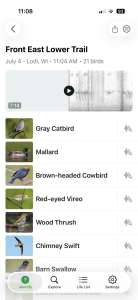
I’m so proud of the walk I took where my Merlin Birding app recorded 21 different birds in about 7 minutes!
Maybe that’s why birding is one of the fastest-growing activities in the country, and I understand why, because I’ve been doing it since college. I took an ornithology class for my zoology degree — a five-credit class that I assumed would be easy. It was not easy. We went camping and went birding, and we went canoeing and went birding, and we drove to Lake Michigan in the middle of winter and went birding. The final exam was a sheet of paper with 100 numbered lines, and our TA took us out to Picnic Point in Madison and pointed out one hundred different birds that we had to identify, mostly by sound.
And somewhere in there I had what the economist Robin Hanson calls a viewquake — an insight that dramatically changes how you see the world. Before, I’d go outside and there are birds singing, and it’s nice: oh, the birds are singing. But once I started birding, I realized that every single bird out there is an individual of a species — with its own song, its own call, its own diet, its own address. And when you know those things, even some of those things, the world outside your door becomes so much richer. I read recently that your life may actually feel longer when you know more about what you’re experiencing. I believe it.
I can tell you that right now, as I write this, the red-winged blackbirds are still calling on the pond. If I walk up into the woods, my Merlin birding app fills up with a whole roster of neighbors. The birds don’t just wander randomly — they have addresses. If you want to hear the indigo buntings, you go to the front part of the hill, where we’ve been restoring the oak savanna, and there they are, perched up above the grasses. There’s a couple of eastern kingbirds who are so territorial that I know exactly where they live, and any time I walk up on the bluff they come out like, what are you doing here? And lately there’s been a lot of screaming from various locations around the farm: it’s a young red-tailed hawk begging for food from its parents.
That’s the experience I want to share this year. Not just the maze; the whole farm as a place where you can go looking. The treasure hunt with wings.
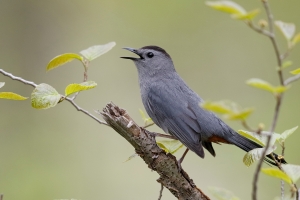
Meet the charming Gray Catbird, who often fools Angie into thinking there’s a cat in the bushes
Of course we’ll be talking about conservation this year — creatures like the rusty patched bumble bee need our help, and we’ll have information about what actually helps them. But I want to be careful about how we do it, because conservation messaging can so easily tip into guilt. “Here I am enjoying my Costco treasure hunt, buying things wrapped in plastic, I’m so terrible, I’m ruining everything” That feeling doesn’t help anybody, and it doesn’t make anyone love the natural world more.
Here’s what I actually believe: it’s easier for us humans to be compassionate, and to do the things that protect our biosphere, when nature isn’t a big abstract thing. When it’s the wrens living outside your door. When you can see them as individuals, or at the very least, as little creatures living their little lives, the same way we’re all just trying to live our little lives. The more you know about them, the more they move inside your circle of concern. I don’t know if that’s an overt message of this year’s maze, but it is certainly my covert one.
So come out this fall. Get lost in a stained-glass bumble bee. Learn some truly unhinged facts about how animals make babies. And then walk up the hill and see who’s home.
With love,
Angie Treinen
*For the record, we have not actually seen any rusty-patched bumblebees at the farm. But we are always hopeful!
Video: the most common birds you can see from your car
Video: Five Owl Calls Everyone Should Know
Visit us at the Treinen Farm Corn Maze & Pumpkin Patch!
W12420 WI Trunk 60
Lodi, WI 53555
Don’t Miss a Thing!
Get our newsletter to get ticket deals, event announcements and other amazing news!